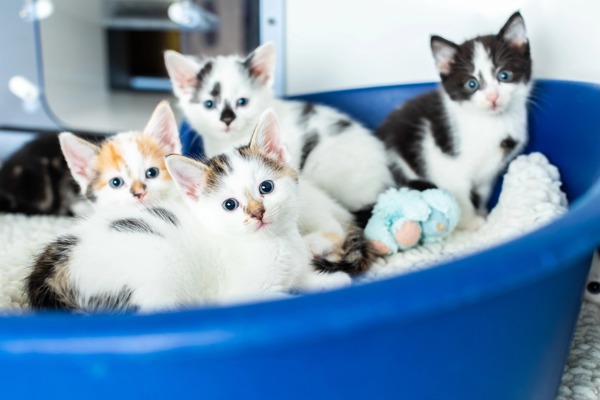
Our new CATS Report 2026 reveals that fewer cats are being neutered than six years ago, while some owners are actively choosing for their cat to have kittens. We explore what’s behind the change and why neutering is so important for cat welfare.
Neutering has long been an important part of our work at Cats Protection. It helps prevent unwanted kittens and has important benefits for the health and welfare of individual cats.
But our new research suggests that attitudes towards neutering may be changing.
Our CATS Report 2026, which explores the lives of cats and their owners across the UK, has found that the proportion of cats being neutered has fallen. It also gives us new insight into why some owners are choosing not to neuter their cat.
So what’s behind the change, and why does neutering still matter?
Are fewer cats being neutered?
In 2020, 88% of pet cats were reported as neutered. In 2026, that figure has fallen to 79%, meaning an estimated 2.1 million pet cats in the UK are not neutered.
There’s also a striking difference depending on the age of the owner. While 94% of cats owned by people aged 55 and over are neutered, this falls to just 67% among owners aged 18 to 34.
Our latest research also sheds some light on why cats are being left unneutered. Among owners whose cats aren’t neutered, 18% told us it was because they want their cat to have kittens, up from 11% in 2023. Another 18% said it was because their cat doesn’t go outside.
Wanting kittens is also more common among owners of pedigree cats than owners of moggies.
Why do people want their cat to have kittens?
For the first time, our CATS Report asked owners who want their cat to have kittens why.
The most common reason was a very understandable emotional one. More than half (55%) said they love their cat so much that they want a kitten just like them. But there’s no guarantee a kitten will grow up to be like their parent. A cat’s personality is influenced by many different factors, and every kitten is an individual.
Others were attracted by the experience of caring for kittens. Two in five (40%) wanted their children to experience looking after kittens, while 34% wanted to experience it themselves. Less than a quarter (23%) were motivated by selling or giving the kittens to friends or family.
But, however appealing a litter of kittens may sound, breeding a cat comes with significant responsibilities, potential risks and costs. If you are considering breeding from your cat, the Canine & Feline Sector Group’s Code of Practice for the Welfare of Cats provides guidance on responsible breeding and caring for cats and kittens.
Is it good for a female cat to have a litter?
One particularly concerning finding from our research is that a third (33%) of owners who want their cat to have kittens believe it is good for a female cat to have a litter.
In fact, cats don’t biologically need to have kittens and there are no physical or psychological benefits to allowing a cat to have a litter before she is neutered.
Pregnancy and birth aren’t risk-free. Complications can occur during pregnancy or labour and may require veterinary treatment, while caring for a mother and her kittens can be demanding.
Female cats can become sexually mature from around four months old, meaning they can become pregnant while they are still kittens themselves. This is why we recommend getting your cat neutered at around four months old.
Does an indoor cat need to be neutered?
Yes. Even if your cat lives indoors, neutering still has important health and welfare benefits.
An unneutered female will regularly come into heat. During this time, she may become very vocal and distressed, and be determined to get outside to find a mate.
Life can be stressful for an unneutered male cat too. Male cats are driven to seek out females and can become frustrated when kept indoors, potentially showing signs of stress or aggression. Neutering can also reduce behaviours associated with finding and competing for a mate, such as roaming, fighting and territorial spraying.
So being an indoor cat isn’t a reason to skip neutering.
What are the benefits of neutering a cat?
As well as preventing unwanted pregnancies, neutering has a number of health and welfare benefits.
For male cats, it can reduce roaming and fighting, which in turn reduces the risk of road accidents, injuries and infectious diseases such as FIV and FeLV. It also removes the risk of testicular cancer.
For females, neutering means they won’t repeatedly come into heat and removes the risks associated with pregnancy and giving birth. It can also greatly reduce their risk of developing mammary tumours, which can be particularly aggressive in cats.
And if you’re worried about putting your cat through an operation, neutering is a routine procedure. At our United Kingdom Cat Centre, Senior Veterinary Surgeon Emily Billings describes it as “a very safe procedure” with “so many benefits”. Cats generally recover well from neutering, with kittens often recovering particularly quickly.
When should I get my cat neutered?
We recommend getting your cat neutered at around four months old, before they have the opportunity to breed.
Our CATS Report 2026 found that just 21% of cats are being neutered by four months, although this has increased from 17% in 2020.
Neutering at this age can also fit well with vaccinations and microchipping as part of your kitten’s preventative healthcare.
But if your cat is already older than four months, don’t worry. Older cats can still benefit from being neutered, so speak to your vet about what’s right for your cat.
Why does neutering matter for all cats?
The decision to neuter one cat can have an impact beyond preventing one litter.
Our CATS Report 2026 found that around 8% of owners of female cats said their cat had a litter in the previous 12 months. Nearly two-thirds (62%) of those litters were planned, rising to 73% among pedigree cats.
But even planned kittens don’t necessarily have a guaranteed home. In 2025, 9,000 kittens were relinquished into Cats Protection care. With rescue and rehoming organisations already operating at capacity, an increase in the number of kittens being born could put even greater pressure on the charity sector.
Neutering helps maintain a balanced cat population, reducing the number of unwanted cats and giving cats already waiting in care a better chance of finding a home.
While our latest research suggests attitudes towards neutering may be changing, our advice hasn’t. Neutering at around four months old is one of the most important things you can do to protect your cat’s health and welfare.
Find out more about neutering your cat and read the CATS Report 2026.